If your dining room feels a little tired, the fix might be simpler than you think. Dining chairs take a surprising amount of wear: daily meals, homework sessions, holiday gatherings, spilled sauce and kids who kneel on the seats to reach across the table. Over time, seat fabric stains and fades, foam flattens, and the whole set starts to look older than it really is.
Reupholstering dining chairs is one of the most approachable furniture projects there is. The frames are often in great shape, the seats are relatively small, and the visual payoff of a matching set in fresh fabric can transform a room. Here’s what to know before you start.
Why Reupholster Dining Chairs Instead of Replacing Them
Dining chairs are often part of a matched set, sometimes paired with a table you love. Replacing them can mean hunting for chairs that work with your table’s style, height and finish. Reupholstering lets you:
- Keep chairs that already fit your table and your room
- Preserve quality wood frames, which are often sturdier than many new options
- Update the look with a new color, pattern or texture
- Improve comfort with new foam
- Choose a more practical fabric for how your household eats and lives
It’s also a meaningful way to keep heirloom sets in the family. Many people recover the dining chairs they grew up with to bring them into their own homes.
Understanding Your Dining Chair Seats
Dining chairs come in a few common seat styles, and the type affects how the work is done.
Drop-In or Slip Seats
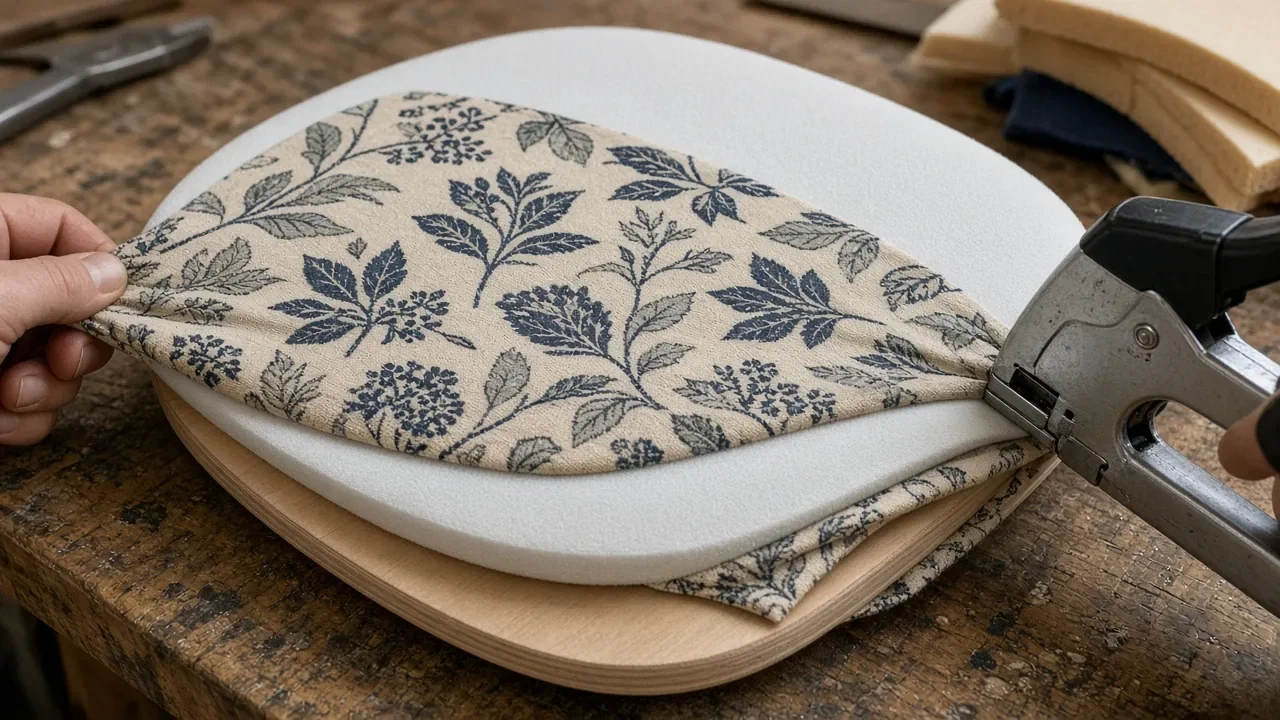
These are the most common and simplest. The seat is a separate board, usually plywood or particleboard, with foam and fabric attached. It sits in the chair frame and is held in place by a few screws underneath. Drop-in seats can be removed, recovered and reinstalled relatively easily.
Fixed or Tight Seats
On these chairs, the upholstery is attached directly to the chair frame. The seat may include webbing, springs or a solid deck. Recovering them takes more work because the fabric must be removed and reattached to the frame itself.
Upholstered Backs
Some dining chairs have padded or fully upholstered backs as well as seats. These need extra fabric and labor, and inside and outside back panels may be finished separately.
Parsons and Fully Upholstered Chairs
Parsons-style chairs are covered almost entirely in fabric, including the legs in some cases. They have a clean, tailored look but require more fabric and more detailed work.
Signs Your Dining Chairs Are Ready for New Upholstery
Not sure whether it’s time? Most dining chairs tell you. Watch for:
- Stains that no longer lift with cleaning
- Fabric that’s faded, thin or fraying along the front edge
- Seats that feel hard or lumpy after a few minutes
- Foam crumbling out from underneath
- Torn dust covers or loose staples below the seat
- A set where a few chairs look noticeably worse than the rest
If several of these sound familiar, a refresh will likely make a bigger difference than you expect.
Choosing Fabric for Dining Chairs
The dining room is one of the messiest rooms in the house, so fabric choice really matters.
Prioritize Cleanability
Food, drinks and greasy fingers are a given. Look for fabrics that resist stains or can be easily cleaned. Performance fabrics, tightly woven synthetics, faux leather and treated fabrics are all popular choices. Check the cleaning code before you commit.
Consider Durability
Dining chairs see constant sliding in and out. Fabrics with good abrasion resistance hold up better over time. Tight weaves also resist snags from belt buckles and rivets on jeans.
Think About Pattern
Small and medium-scale patterns are forgiving and can hide minor stains. Large patterns can look great but need careful placement so each seat looks consistent. Ask how the pattern will be centered on each seat.
Coordinate, Don’t Necessarily Match
The fabric should work with your table, floors, walls and nearby furniture. Some people choose a different fabric for the two head chairs (sometimes called host and hostess chairs) for a subtle designer touch.
Leather and Faux Leather
These wipe clean easily, which makes them appealing for families. Quality varies, so look for durable, well-made options that won’t crack or peel quickly.
Foam: The Secret to Comfortable Dining Chairs
Many older dining chairs have thin, compressed foam that leaves you feeling the hard seat underneath after a few minutes. Replacing it is often the biggest comfort upgrade.
- Firmness. Dining seats typically use firmer foam than lounge furniture, because you sit upright and want support.
- Thickness. A little extra thickness can add comfort, but it also raises seat height and can affect how the seat fits in the frame and how the chair sits at the table.
- Batting or wrap. A layer of batting over foam softens edges and helps fabric lie smoothly.
Your upholsterer can recommend a combination that suits your chairs and how long you tend to sit at the table.
Style Ideas for a Dining Chair Refresh
New fabric is a chance to change the personality of your dining room. A few ideas to spark inspiration:
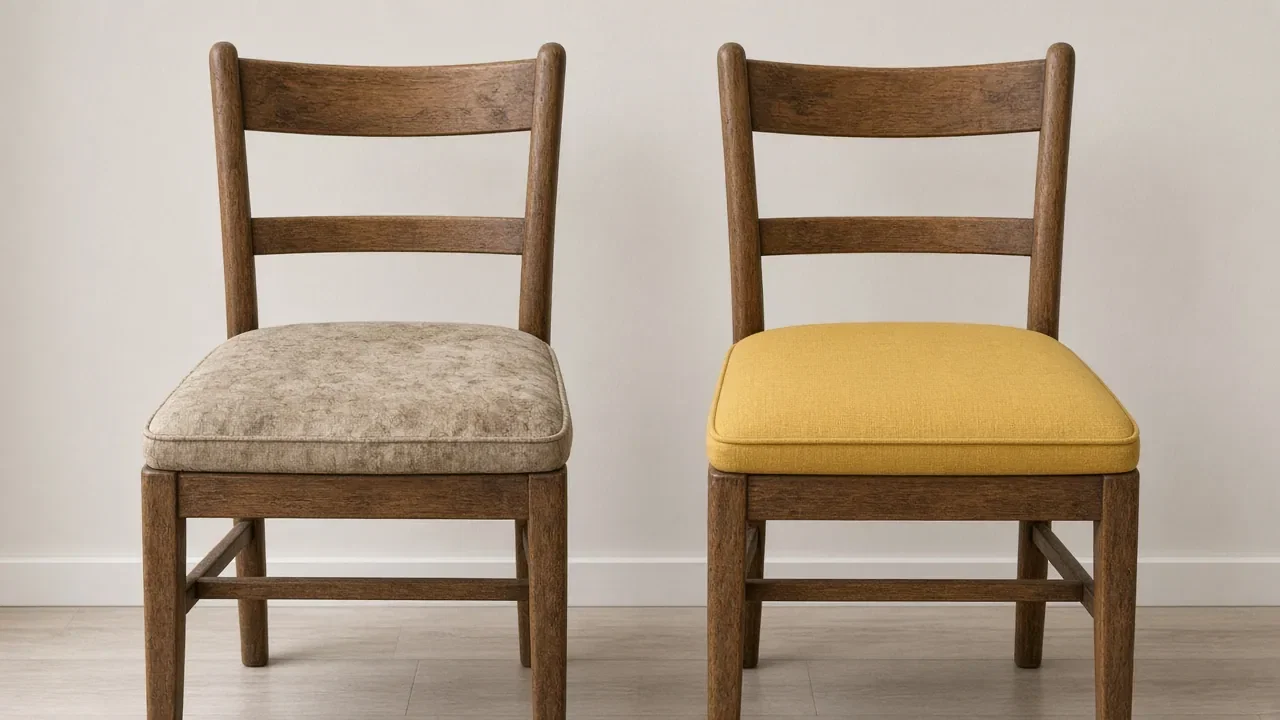
- Go bold on the seats. If your walls and table are neutral, a saturated color or lively pattern on the chair seats adds energy without overwhelming the room.
- Add welting or piping. A contrasting welt around the seat edge gives a tailored, finished look.
- Try nailhead trim. On chairs with upholstered backs or fixed seats, decorative nailheads can add a traditional or rustic touch.
- Use texture. Subtle textures like a tight boucle-look performance fabric, a herringbone or a heathered weave add depth while staying practical.
- Mix fabrics thoughtfully. Use one fabric on the seats and a coordinating fabric on the backs, or set the head chairs apart with a complementary pattern.
- Consider a channeled or tufted back. For chairs with upholstered backs, simple channels or buttons can change the look entirely.
Bringing a few photos of rooms you like helps your upholsterer understand the style you’re after.
Making Mismatched Chairs Feel Like a Set
Not every dining set started out matching. Many people collect chairs over time, or inherit a few from different family members. Reupholstering all of them in the same fabric is an easy way to pull a mismatched group together. Different frames suddenly look intentional when their seats share a color and texture. If the wood finishes vary a lot, painting or refinishing frames to a single color can complete the effect.
Plan Ahead for Holidays and Gatherings
If you want your chairs ready for a holiday meal, a graduation party or out-of-town guests, plan early. Fabric selection and ordering can take time, and busy seasons fill up quickly. Getting started well before a big event gives you time to choose fabric without rushing and to have chairs back home with room to spare.
What to Expect From the Process
A typical dining chair reupholstery project goes something like this:
1. Assessment. Photos or a quick look at one chair helps determine the seat type, construction and condition. 2. Fabric selection. You choose fabric from samples or bring your own, and the yardage is calculated for the whole set. 3. Drop-off or pickup. For drop-in seats, sometimes only the seats need to come to the shop. For fixed seats and upholstered backs, the whole chair usually does. 4. Stripping and repair. Old fabric, foam and staples are removed, and any loose joints or damaged seat boards are addressed. 5. New foam and fabric. Fresh foam, batting and fabric are installed, with attention to consistent pattern placement and smooth corners. 6. Finishing. Dust covers are added underneath, and seats are reinstalled.
Should You Fix Wobbly Chairs at the Same Time?
Loose joints are common in older dining chairs, especially ones that get leaned back on. If the chairs are already in the shop, it’s a good time to have joints checked and reglued. A beautiful new seat on a wobbly chair won’t feel like much of an upgrade.
Do-It-Yourself vs. Professional
Simple drop-in seats are sometimes a DIY project. If you’re comfortable with a staple gun, you can recover a basic seat at home. A professional job makes the most sense when:
- Seats are fixed to the frame or include springs
- Chairs have upholstered backs or welting
- You want perfect pattern alignment across the whole set
- Frames need repair
- You’re working with leather or difficult fabrics
- You simply want it done well without the time commitment
Caring for Newly Upholstered Dining Chairs
- Blot spills quickly with a clean cloth.
- Vacuum seats now and then to remove crumbs.
- Consider a fabric protector if your fabric is compatible.
- Lift chairs rather than dragging them, to protect joints and floors.
- Keep the leftover fabric for future repairs, if there is any.
Frequently Asked Questions
How much fabric do I need for dining chairs?
It depends on seat size, whether backs are upholstered, the fabric width and pattern repeat. Your upholsterer will calculate yardage for the whole set.
Can I bring my own fabric?
Often, yes, as long as it’s suitable for upholstery. Durable, tightly woven fabrics work best for dining chairs.
Can you reupholster just the seats?
Yes. Drop-in seats are especially easy to do on their own, and the chair frames may not even need to leave your home.
Can you add comfort to hard dining chairs?
New, thicker or better-quality foam can make a big difference, as long as it still fits properly in the frame.
Do you work with restaurants too?
Yes. Along with residential work, Leo’s Upholstery specializes in commercial upholstery, including restaurant chairs, booths and bar stools.
Refresh Your Dining Set
Reupholstering your dining chairs is a simple way to make your dining room feel new again. Leo’s Upholstery in San Leandro helps homeowners across the East Bay and Bay Area refresh chairs of every style. Learn more about our chair upholstery and residential upholstery services.
Request a quote online with a photo of one chair and the number in your set, or call us at (510) 895-3632.